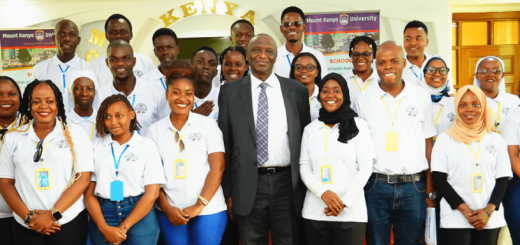
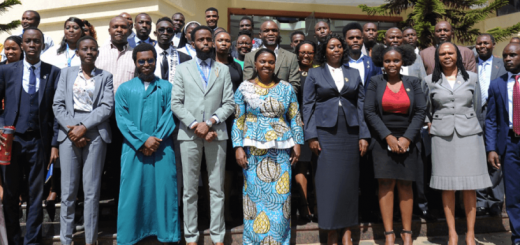
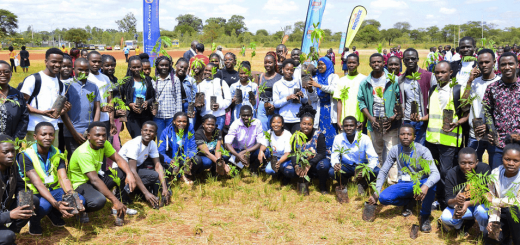
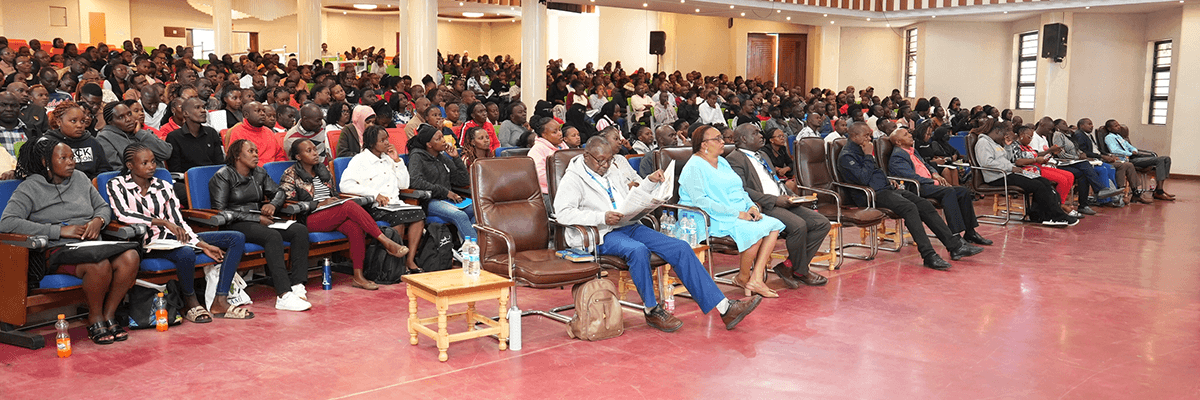
MKU hosts successful orientation for DIBeL students
Theme: Navigating Career Growth in the Age of Artificial Intelligence
Preliminaries
On behalf of the University Management, the Senate, the entire University fraternity, and on my own behalf, I am delighted to warmly welcome you to Mount Kenya University (MKU) as our new students under the Open, Distance and E-Learning (ODEL) programme, also known as the Distance and Institution-Based Learning (DIBeL) mode.
You had many options to choose from, and your decision to join MKU is both significant and commendable. It reflects a clear commitment to advancing your career, upgrading your skills, and investing in your future. I sincerely congratulate you for making this important choice.
At MKU, we pride ourselves on working as a team to unlock infinite possibilities for our students. Increasingly, we are earning recognition as a fast-emerging global hub of excellence in education, research, and innovation, in alignment with our Vision and Mission.
The Unique Strengths of MKU as an Institution of Higher Learning
Ladies and Gentlemen,
Before I delve into the main theme of my address, allow me to highlight a few important aspects that define MKU and the ODEL/DIBeL programme you have joined.
First, MKU is a university that values structure, predictability, and student success. From the moment you begin your studies, you are able to clearly project your academic journey, including your expected graduation date. We are committed to providing quality services that support timely completion of your studies—provided you also play your role diligently.
You will receive continuous guidance from your lecturers, Deans of Schools, and Student Welfare teams to ensure that your learning progression remains on track. However, always remember: you are the primary driver of your academic journey. With discipline, commitment, and focus, you will not only meet expectations—you will exceed them.
Second, we operate within a dynamic education sector that is undergoing significant transformation. The shift towards Competency-Based Education (CBE) is now a national priority. At MKU, we have embraced this transition by reviewing and aligning our curricula to ensure they are competency-based, relevant, and industry-responsive—particularly in programmes such as the Bachelor of Education.
This strategic direction ensures that you graduate not only with knowledge, but with demonstrable skills and competencies that make you highly competitive in the job market.
Navigating Career Growth in the Age of Artificial Intelligence
Ladies and Gentlemen,
This brings me to the theme of my address today:
“Navigating Career Growth in the Age of Artificial Intelligence.”
Career growth can be understood as the advancement of one’s professional journey through higher responsibilities, improved remuneration, and—most importantly—expanded skill sets.
It is this expansion of skills that has brought you to MKU.
But why must we speak about Artificial Intelligence (AI) in relation to your career growth?
We do so because AI is no longer a distant concept—it is a present reality. It has permeated every aspect of our lives. From teaching and learning, research and assessment, to lesson planning, professional practice, and even job interviews—AI is influencing how we think, work, and create.
AI is here with us, and it is here to stay.
The critical question, therefore, is:
How do we navigate career growth in an AI-driven world?
Allow me to share a few guiding principles:
- a) Be a Master of AI, Not a Servant
At MKU, we encourage the responsible and informed use of AI. Indeed, we are integrating AI into our academic and research ecosystems, supported by institutional guidelines and an emerging AI policy framework.
However, you must ensure that AI remains a tool that enhances your thinking—not one that replaces it.
Use AI to support your learning, but never surrender your intellectual independence.
- b) Embrace Lifelong Learning through Continuous Re-tooling
The AI era demands constant learning, unlearning, and relearning. New tools, technologies, and methodologies are emerging daily.
You must therefore make a deliberate commitment to continuous self-improvement.
Be proactive in acquiring new skills.
Be adaptable in responding to change.
In essence: Become a lifelong learner.
- c) Uphold Integrity in the Digital Era
There is a saying: “Intelligence without integrity is dangerous.”
In a time when AI can generate essays, reports, and project proposals, the temptation to take shortcuts is real. However, academic dishonesty undermines your growth and devalues your qualifications.
Use AI responsibly—as a tool for learning, idea generation, and support—not as a substitute for your own effort.
Adhere strictly to University policies, guidelines from your lecturers, and professional standards.
Your integrity will define your credibility.
- d) Leverage AI for Innovation and Entrepreneurship
MKU is a hub of innovation and enterprise. Through partnerships with industry and other stakeholders, we provide platforms for students to develop innovative ideas and entrepreneurial ventures.
AI, when used responsibly, can be a powerful driver of innovation. You will have opportunities to participate in innovation challenges, hackathons, and collaborative projects that expose you to global digital ecosystems.
Let AI be your partner in creating solutions—not just consuming them.
Conclusion
In conclusion, I once again congratulate you for joining Mount Kenya University.
You have earned your place here, and we are fully committed to supporting your academic, professional, and personal growth—especially within the flexible and empowering ODEL learning environment.
As you embark on this journey, I encourage you to:
- Take ownership of your learning
- Embrace lifelong learning
- Use technology wisely and responsibly
- Uphold integrity in all that you do
- Prepare yourself to thrive in an AI-driven world
I wish you a fulfilling and transformative learning experience—one that will shape you into competent, innovative, and ethical leaders ready to navigate the future with confidence.
GOD BLESS YOU ALL!
Prof. Deogratius JAGANYI
Vice-Chancellor